
Whauwhaupaku: When the Stars Flower Within Us


The Mauri of Whauwhaupaku
Sometimes the most familiar rākau are the ones we stop seeing.
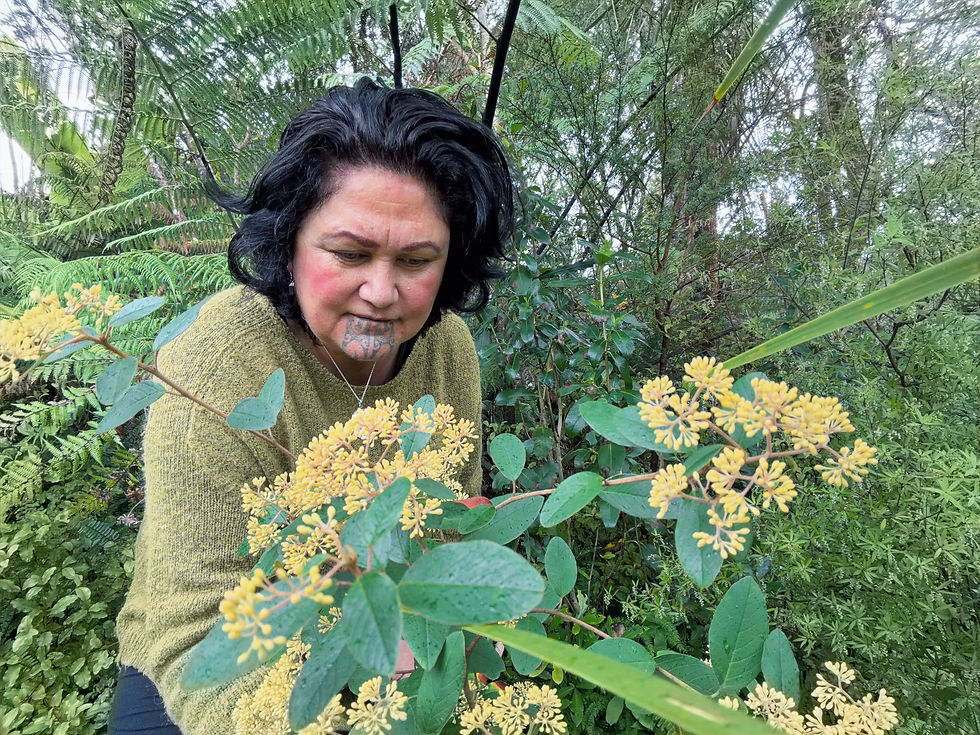
Whauwhaupaku (Pseudopanax arboreus), commonly known as five-finger, grows abundantly throughout much of Aotearoa. Its broad, glossy leaves and spreading form are familiar within our ngahere, gardens and regenerating bush. Yet during winter, something extraordinary begins to emerge.
From around June through to August, Whauwhaupaku produces clusters of flower buds in shades of burgundy, rosewood and deep purple. When we look closely, the buds resemble tiny starbursts held upon the branches. Their colour has a sound of its own—a vibration that can stop us in our tracks and invite us to move closer.
Perhaps this is the mauri of Whauwhaupaku calling us to remember that this is not simply another green-leaved tree.
The Mother Tree
I have lived in this home since 2009. At the end of the deck stands a mature Whauwhaupaku that I see every day. During summer, my favourite place to sit is beneath her branches. A birdbath sits nearby, bringing manu into this small forested area where many other Whauwhaupaku now grow.
I think of her as the mother tree. Beneath and around her, seedlings continually appear—the next generations emerging within the shelter of her presence.
Around 2011, I sat on the deck one spring and deliberately began tuning into her. I recorded what I noticed in a notebook: the leathery strength of her leaves, the veins that reminded me of pathways beneath the skin, and the branching forms that resembled neurons and dendrites within the nervous system.
I wrote that the tree felt “friendly yet aloof”—strong, sturdy, humble and partially hidden. I experienced her as a protector and a nurturer.
Looking back, that was the beginning of a relationship that has continued for more than fifteen years. Since then, Whauwhaupaku has been an enormous support for me and for the work I do.
She has taught me that not every rākau enters our lives as something to be harvested or consumed. Sometimes the rongoā is the enduring relationship—the shelter, presence and quiet support of a living being who has stood beside us through the unfolding of our lives.
He tamaiti nō ngā whetū
In some iwi kōrero, Whauwhaupaku and Puawānanga are the children of Puanga and Rehua.
Within this whakapapa, Puanga is the star known astronomically as Rigel, the brilliant blue supergiant in Orion. Puanga appears in the morning sky during winter and, for many iwi, signals the beginning of a new year and a new seasonal cycle.
Rehua, associated in this kōrero with Antares, is the great red supergiant in the heart of Scorpius. Its warm reddish light is unmistakable in the night sky.
One glows blue-white and the other red. One draws our attention towards the morning; the other holds its presence within the night. Their children flower upon the earth as winter begins to release its hold.
Knowing this whakapapa changes the way we encounter Whauwhaupaku. The rākau is no longer isolated from the wider universe. Its flowering becomes part of a much greater movement occurring between Ranginui, Papatūānuku and all living things.
The star-shaped flower clusters become an earthly expression of their celestial whakapapa.

Stirred into Awakening
At this time of year, another remarkable relationship becomes visible.
Late in the night, Rehua descends towards the western horizon as Puanga begins to rise in the east. For a short time, both stars can be seen holding broadly opposite sides of the sky—one departing as the other arrives.
I sense a pulling power within this moment.
These are two immense celestial beings, each carrying its own mauri and occupying opposing thresholds of the night. Between them there appears to be tension, movement and exchange—as though one force is releasing while another is awakening.
I have often wondered whether this celestial opposition might also be felt within the body of Papatūānuku—whether it somehow corresponds with the stirring of Rūaumoko beneath the whenua.
Rūaumoko, who remains within the womb of Papatūānuku, is associated with earthquakes, volcanic activity and the movements beneath the earth. His stirring signals that change is occurring. Something held quietly below the surface is preparing to emerge.
Within the mātauranga shared with me, Whauwhaupaku is stirred by the rumblings of Rūaumoko and bursts into flower.
I do not offer the relationship between these stars and earthquakes as a scientific explanation. It is an intuitive question that has arisen through observing Rehua and Puanga, the flowering of Whauwhaupaku and the seasonal movements of te taiao.
Perhaps the stars do not have to cause the movement below to be a tohu of it.
Perhaps what occurs above and what occurs below are different expressions of the same great movement through whakapapa. Rehua descends. Puanga rises. Rūaumoko stirs beneath the whenua. Whauwhaupaku flowers upon it. The season turns, and mauri begins moving from one state into another.
During the coldest part of the year, while much of the natural world appears quiet, Whauwhaupaku begins preparing new life. Its flowers announce movement, transition and the approach of another season.
Sometimes new beginnings do not arrive loudly. They begin as a subtle stirring within us—a feeling, an idea, a restlessness or a knowing that something is ready to change.
In this way, Whauwhaupaku stands between powerful forces: between earth and sky, winter and spring, darkness and returning light, stillness and awakening.
Whauwhaupaku reminds us to pay attention to those inner rumblings.
Before asking what it is used for
When learning about rongoā, we can be quick to ask:
What is this plant used for?
What part do we harvest?
What conditions can it treat?
These are valuable questions, but they should not always be our first questions.
Not all rākau are rongoā to be prepared and consumed. Some are rongoā to connect with.
Some do not need to be cut, harvested, boiled or swallowed. Their rongoā is carried through their presence and through the relationship we build with them. We may receive it by sitting beneath their branches, observing their flowering, sensing their mauri or allowing them to direct our awareness somewhere beyond ourselves.
Whauwhaupaku lifts our gaze from the whenua towards ngā whetū.
Through its whakapapa to Puanga and Rehua, it becomes a pathway between Papatūānuku and Ranginui. It invites us to expand beyond the immediate concerns of the physical world and remember that our whakapapa extends into the heavens.
This connection can lift the mauri. It can bring us into alignment with the movements of the stars and open us to a higher state of being. The rākau becomes a doorway through which we can contemplate the vastness of the universe—and recognise that this same vastness also exists within us.
Whauwhaupaku has recorded physical uses for the tīnana. Hēoi anō, the rongoā being revealed here is not something that needs to be consumed.
The rongoā is the connection.
It is the moment our awareness moves beyond the visible form of the rākau and follows its whakapapa into the night sky. It is the relationship formed between our own mauri, the mauri of Whauwhaupaku and the celestial presence of Puanga and Rehua.
Before asking what Whauwhaupaku can give us, perhaps we should ask:
Who is Whauwhaupaku?
Where does it come from?
What whakapapa does it carry?
Where is it inviting me to go?
Perhaps the rongoā is not always what we take from the rākau.
Perhaps the rongoā is where the rākau is able to take us.

An invitation to observe
If Whauwhaupaku grows near you, take some time to visit it during its flowering season.
Look closely at the deep burgundy buds and their star-like formations. Notice the birds and insects drawn towards the flowers. Sit nearby without initially needing to harvest anything. Return over several days and observe what changes.
When they are visible, look for Puanga in the morning and Rehua in the night. Allow the connection between rākau, whenua, sky and self to reveal itself in its own time.
Te taiao continually communicates with us. Our task is to become quiet enough to notice.
The stars above are the cells within.
And perhaps those goosebumps we feel while looking towards the heavens are our cells remembering.
This kōrero forms part of the developing Mauri Kura book. Each rākau is being written through He Rākau, He Rongoā and He Mauri, before turning the teaching gently towards ourselves. What I share here is one doorway into that fuller journey.


Comments